Cart
0

Last Updated: October 23, 2026
Quick Summary
Essential fitness equipment for small home gyms is a resistance band set, one pair of adjustable dumbbells, and a jump rope. That trio covers pushing, pulling, squatting, hinging, and conditioning, the foundation of any full-body workout. Everything else is an upgrade, not a requirement.
- The figure-8 resistance band is the standout value pick at $10 and stores in a drawer.
- A starter kit under $100 covers full-body strength and conditioning with almost no floor footprint.
- Measure clear floor, ceiling height, door width, and wall storage space before buying anything.
- Allow a 1.5 m x 1.5 m clear square if you plan to jump rope indoors.
- Skip anything with a motor, single-exercise items, and gear needing permanent floor space first.
Table of Contents
- Why Small Home Gyms Need Smart Equipment Choices
- Best Home Gym Equipment for Small Spaces: Quick Comparison
- Minimum Home Gym Equipment: What You Actually Need
- Apartment Workout Equipment: Noise, Floor Protection, and Neighbor-Friendly Choices
- Budget-Friendly Home Gym Equipment: Cost Breakdown and Value Picks
- How to Plan Your Layout and Storage in a Small Space
- Sample Workouts Using a Minimal Equipment Set
- Frequently Asked Questions
Why Small Home Gyms Need Smart Equipment Choices
Essential fitness equipment for small home gyms is the minimum set of compact, multi-purpose tools that let you train strength and cardio in a limited footprint without sacrificing results. The constraint is not motivation. It is floor space, noise, and storage.
Most people buy too much, too fast. A treadmill arrives, then a bench, then a rack, and suddenly the spare room is a warehouse with no room to actually move.
At Calmpulseco, we curate equipment around that principle: every item should earn its square metre.
Best Home Gym Equipment for Small Spaces: Quick Comparison
The best small-space equipment combines multiple training functions in one compact footprint, so a single purchase replaces three or four bulky machines. Here is how the core categories compare on space, cost, and what they train.
| Equipment | Approx. Footprint | Price Range | Trains | Best For |
|---|---|---|---|---|
| Resistance band kit | Drawer-sized | $10-$111 | Full body strength | Beginners, travel |
| Adjustable dumbbells | 0.5 sq m | $197 (4kg/12kg) | Strength, shaping | Progressive loading |
| Mini stepper | 0.12 sq m | $132 | Cardio, legs | Apartments |
| Exercise mat (7x5ft) | Rolls away | $201 | Floor work, protection | Noise and joint care |
| Jump rope | Pocket-sized | $19 | Conditioning | Warm-ups, intervals |
| Push-up bars | Drawer-sized | $87 | Upper body | Wrist-friendly pressing |
| Grip trainer | Handheld | $30 | Forearms, grip | Desk-side training |
The pattern is clear: the cheapest items cover the most training variety per centimetre. Start there before spending on anything with a motor.
Minimum Home Gym Equipment: What You Actually Need
Minimum home gym equipment is a resistance band set, one pair of adjustable dumbbells, and a jump rope. That trio covers pushing, pulling, squatting, hinging, and conditioning, which is the foundation of any full-body workout.
Everything else is an upgrade, not a requirement. A common mistake is buying a bench before owning a single resistance band, then discovering the bench only supports two exercises they do.
Here is the minimum kit we would build, in order:
- Resistance bands first. The Full Body Strength & Resistance Training Kit covers functional strength, speed, and jump work in one bag.
- A jump rope second. The rubber jump rope handles cardio without a machine.
- Dumbbells third. The ladies fitness dumbbell comes in 4kg and 12kg options for progressive loading.
- Push-up bars fourth. The rotating push-up bar protects wrists during pressing work.
Pro Tip
Buy the band set and jump rope together before anything else. Together they cost less than most single machines and cover more movement patterns than a bench and rack combined.
Apartment Workout Equipment: Noise, Floor Protection, and Neighbor-Friendly Choices
Apartment workout equipment should be quiet, low-vibration, and cushioned, because impact noise travels through floors faster than any other complaint source.

The fix is a proper mat, not a towel. The 7x5ft high-density exercise mat is 7mm thick with a textured grip base, which absorbs impact and protects hardwood from scratches.
For cardio, the hydraulic mini stepper runs on a hydraulic drive system that moves quietly and needs only 301 x 405mm of floor. It also includes resistance bands and an LCD monitor.

Watch Out
Skipping rope directly on a hardwood floor in an apartment is the single most common noise complaint trigger. Always place a thick mat underneath, and avoid jumping after late evening hours.
Budget-Friendly Home Gym Equipment: Cost Breakdown and Value Picks
Budget-friendly home gym equipment means prioritizing items with the lowest cost per training use, not the lowest sticker price. A $19 jump rope used four times a week beats a $1,000 machine used twice a month. The practical way to plan a budget is to build in tiers: a starter kit that covers the minimum, a mid-range add-on that expands training options, and a premium bundle for readers who want one purchase to cover strength and cardio.
Full body strength & resistance training kit →
Cost-per-use math for a starter setup
Cost per use is total price divided by the number of sessions in the first year. The table below uses conservative weekly-use estimates so the comparison stays honest.
| Item | Price | Weekly Uses | Cost Per Use (Year 1) |
|---|---|---|---|
| Figure-8 resistance band | $10 | 5 | $0.04 |
| Jump rope | $19 | 4 | $0.09 |
| Grip strength trainer | $30 | 5 | $0.12 |
| Yoga resistance belt set | $34 | 4 | $0.16 |
| Rotating push-up bars | $87 | 3 | $0.56 |
| Resistance & cardio bundle | $294.50 | 6 | $0.94 |
The figure-8 resistance band is the standout value pick at $10. It targets arms, back, and shoulders, corrects rounded shoulders from desk work, and stores in a drawer. The Resistance Training & Cardio Bundle at $294.50 bundles three resistance bands, three super bands, and a high-speed aluminium jump rope with a carry bag.

Starter, mid-range, and premium bundles
- Starter (under $100): resistance band kit, jump rope, and grip trainer. This covers full-body strength and conditioning with almost no floor footprint. It is the right first purchase for most small-space setups.
- Mid-range ($100-$300): add adjustable dumbbells, a 7x5 ft mat, and rotating push-up bars. This tier adds progressive loading and floor protection, which matter if you train on hardwood or in an apartment.
- Premium ($300+): the Resistance Training & Cardio Bundle plus a mini stepper and a mat. This covers strength, cardio, and floor work in one order and is the closest thing to a complete small-gym kit without a rack or bench.
Total setup cost and what to skip first
A realistic starter setup lands in the low hundreds of dollars, while a mid-range kit with dumbbells and a mat moves into the several-hundred range. The premium bundle plus a stepper is the top of the small-space range before you consider racks or benches. The items to skip first are anything with a motor, anything that only supports one exercise, and anything that needs permanent floor space. Those are the purchases that most often go unused in a small room.
How to Plan Your Layout and Storage in a Small Space
Layout planning for a small home gym starts with measuring your usable floor area, then allocating zones for standing work, floor work, and storage. Most people skip the measuring step and buy equipment that does not fit the room they have.
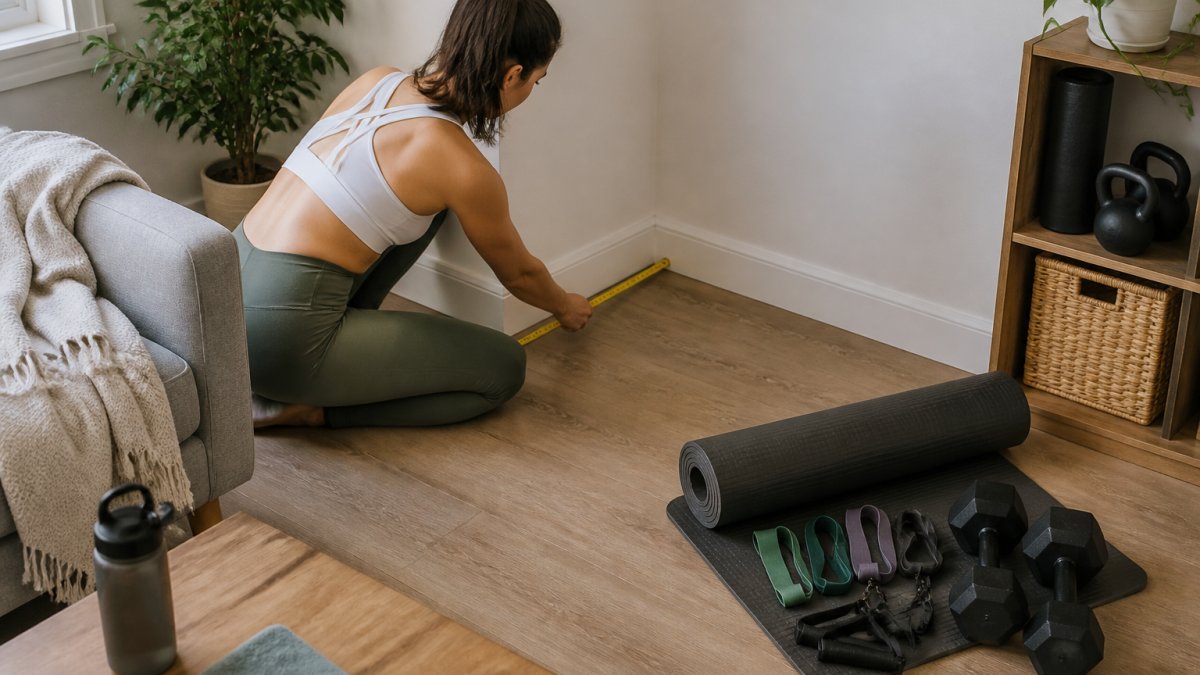
Measure these four numbers before you buy anything
- Clear floor depth and width. You need roughly 2 m x 1 m of clear floor for mat work (lying, kneeling, core) and about 1.5 m x 1 m for standing work such as a stepper or band exercises. If you plan to jump rope, allow a 1.5 m x 1.5 m clear square so the rope does not catch furniture.
- Ceiling height. A jump rope needs about 30 cm of clearance above your head at the top of the arc. Measure from the floor to the lowest obstruction, ceiling, light fixture, or ceiling fan, not just to the ceiling itself. If you are taller than average or the room has a low bulkhead, test the rope length before committing to rope work indoors.
- Door and hallway width. Any folding bench, rack, or stepper must fit through the door and around the corner to reach the room. Measure the narrowest point on the path, not just the room.
- Wall space for vertical storage. A 60 cm-wide wall strip can hold a hook rail for bands and ropes, and a low shelf or dumbbell stand keeps weights off the floor. Vertical storage is what lets a multipurpose room switch back to living space in minutes.
Zone the room in three bands
- Standing zone: the stepper, jump rope, and any standing band work. Place this on the mat edge or on a hard floor with a small mat underneath.
- Floor zone: the 7x5 ft mat for pressing, core, and mobility. Leave at least 60 cm of clear space on the open sides so you can get up and down without hitting furniture.
- Storage zone: a hook rail, a drawer, or a low shelf. Bands, ropes, and grip trainers live here; dumbbells sit on the floor or a low stand within arm's reach of the standing zone.
Clearance and safety checks
- Keep at least 60 cm between the edge of the mat and any wall or furniture you could strike during floor work.
- Do not place a stepper or jump rope zone under a low ceiling fixture or a ceiling fan.
- If the room doubles as a bedroom or living room, choose roll-away or foldable items so the floor clears completely between sessions.
- Check that any doorway pull-up bar or suspension trainer anchor is rated for your body weight and installed per the manufacturer's instructions; doorway frames vary, and not every frame is suitable.
Key Takeaway
If your room cannot fit a 2 m x 1 m clear floor zone, skip the mat and use a smaller footprint setup built around bands, a jump rope, and a stepper. Measure the clear floor, ceiling clearance, door width, and wall storage strip first, those four numbers decide what actually fits.
Sample Workouts Using a Minimal Equipment Set
A minimal equipment set can deliver a complete week of training using only bands, a jump rope, dumbbells, and a mat. The key is pairing one strength movement with one conditioning burst per session.
Session A: Full-body strength (25 minutes)
- Band squats, 3 sets of 12
- Dumbbell floor press, 3 sets of 10
- Band rows, 3 sets of 12
- Rotating push-ups, 3 sets of 8
- Jump rope intervals, 5 rounds of 30 seconds
Session B: Upper body and posture (20 minutes)
- Figure-8 band shoulder pulls, 3 sets of 15
- Push-up bar presses, 3 sets of 10
- Grip trainer holds, 3 sets of 20 seconds
- Band chest pulls, 3 sets of 12
Session C: Cardio and conditioning (20 minutes)
- Mini stepper, 10 minutes steady
- Jump rope, 5 rounds of 40 seconds
- Mat core work, 5 minutes
Pro Tip
Alternate Session A and B across the week and slot Session C in on your busiest day. Three short sessions beat one long one you keep skipping.
Building a home gym in a small space is less about buying more and more about choosing well. The challenge is real: limited floor, shared walls, and a budget that has to justify every purchase.
Frequently Asked Questions
How big is a small home gym?
A small home gym typically fits in a 3x3 metre (10x10 foot) area, or even a 2x2 metre corner. The key is using compact equipment that stores away. For example, a 7x5ft exercise mat can define your workout zone, and resistance bands or a jump rope take up almost no space when not in use. Measure your available floor space first, then choose equipment that fits within it, leaving room to move safely.
What equipment do you need for a small home gym?
Start with a non-slip exercise mat for floor protection and joint support, a set of resistance bands for strength training, and a jump rope for cardio. Add adjustable dumbbells or a compact stepper if space allows. For bodyweight training, rotating push-up bars add upper-body variety. These items cover strength, cardio, and mobility without bulky machines, making them ideal for small home gyms.
What compact equipment works for both strength and cardio?
A resistance training and cardio bundle often combines resistance bands with a jump rope, giving you both strength and cardio tools in one compact package. A mini stepper with resistance bands also works for both, as it provides cardio stepping while the bands add upper-body resistance. These multi-purpose items save space and money compared to buying separate machines.
How much does it cost to set up a small home gym?
You can build a functional small home gym for under $100 by starting with a figure-8 resistance band ($10) and a jump rope ($18.99). Adding a yoga resistance belt set ($34.37) and rotating push-up bars ($86.92) brings the total to around $150. For a more complete setup, include an exercise mat ($201.61) and a mini stepper ($132.21). Prioritize budget-friendly home gym equipment based on your goals.